
Attention Mechanisms Affect Hallucination Rates
Attention mechanisms play a critical role in modern artificial intelligence models, particularly in natural language processing and computer vision. These mechanisms determine how a model prioritizes different pieces of information when generating responses or making predictions. While attention has significantly improved AI performance, it also influences the occurrence of hallucinations—instances where AI generates incorrect, misleading, or fabricated information. Understanding how attention mechanisms affect hallucination rates is crucial for developing more reliable AI systems.
In transformer-based architectures, such as GPT and BERT, self-attention mechanisms enable models to weigh the importance of different words within a sentence. This helps in understanding context and generating coherent responses. However, the probabilistic nature of attention can sometimes lead to overconfidence in incorrect information. When the model assigns high attention weights to misleading or ambiguous data, it increases the likelihood of hallucinations. This is especially problematic when training data contains inconsistencies, biases, or gaps, as the model may amplify these errors rather than correct them.
Another factor influencing Al hallucination detection and accuracy improvement is long-range dependency handling. Attention mechanisms allow models to capture dependencies between words that are far apart in a sentence, improving comprehension. However, in cases where the model misinterprets relationships between distant words or concepts, hallucinations can emerge. This is particularly noticeable in longer documents, where the AI may struggle to maintain contextual accuracy across multiple paragraphs. In such cases, techniques like sparse attention, which selectively focuses on relevant parts of the text, can help mitigate hallucinations by reducing unnecessary noise in the model’s decision-making process.
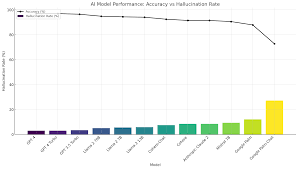
How Do Attention Mechanisms Affect Hallucination Rates?
In multimodal AI systems that process both text and images, attention mechanisms guide how different modalities interact. For example, vision-language models such as CLIP and DALL·E use cross-attention mechanisms to align textual descriptions with visual elements. While this improves accuracy in tasks like image captioning, it also introduces risks of hallucinations if the attention mechanism fails to align inputs correctly. If the model incorrectly assigns high attention to irrelevant features in an image or misinterprets the relationship between text and visuals, it may generate misleading outputs. Researchers address this issue by refining cross-modal attention layers and incorporating external validation methods.
Hallucination rates also depend on how attention mechanisms handle missing or uncertain information. In scenarios where data is incomplete, AI models may attempt to “fill in the gaps” based on learned patterns. This generative behavior can be beneficial in some cases, such as creative writing, but problematic in factual domains like medical or legal AI. Dynamic attention mechanisms that adjust weight distribution based on uncertainty levels can help reduce hallucinations by preventing overcommitment to speculative information.
Despite these challenges, attention mechanisms remain one of the most effective tools for improving AI performance. By continuously refining attention-based models through techniques like reinforcement learning, retrieval-augmented generation, and knowledge grounding, researchers can minimize hallucination rates. As AI systems become more sophisticated, balancing attention precision with contextual understanding will be key to developing models that are not only powerful but also trustworthy.